If you've ever filed a ticket to change a single headline and waited two weeks for it to go live, you already know something most CMS vendors won't say out loud: the sticker price was never the real cost.
The real cost is the developer you had to hire to do what your content team should be able to do themselves. It's the six-month implementation that was supposed to take six weeks. It's the plugin you're afraid to update and the one you're afraid not to update. It's the AI everyone's talking about, sitting behind a licensing tier you haven't budgeted for.
This isn't a takedown of AEM, Optimizely, or WordPress. All three are legitimately good at what they were built for. The problem is what they were built for was never a nonprofit running five chapter sites, a nine-person marketing team, and a board asking why the website still looks like it did in 2019.
Here's an honest look at where each one earns its reputation, where nonprofits specifically feel the strain, and what actually changes with a platform built around that gap instead of around enterprise retail or hobbyist blogging.
Adobe Experience Manager: built for retailers with a platform team to spare
AEM is not a bad product. It's an excellent product for a Fortune 500 company with a dedicated AEM practice — solution architects, certified developers, a governance team, and a budget line that assumes all of that. If your organization has that, AEM will do almost anything you ask of it.
Here's the catch: almost nothing you ask of it happens without a developer.
Ask anyone who's managed an AEM instance and you'll hear a version of the same story. Publishing a new page is fine. Changing the structure of a page — a new content block, a new component, a new layout pattern — routes through a dev queue, because AEM's component model is deliberately dev-owned by design. That's a feature for a bank. For a nonprofit marketing team of three, it's a permanent bottleneck between an idea and a published page.
The talent problem compounds it. AEM developers are specialized, in demand, and expensive — and if the one person who understands your instance leaves, you don't just lose a team member, you lose institutional knowledge of your own website. Implementations commonly run six months to a year before a nonprofit sees real value, with solution architects and systems integrators billing throughout.
And AEM's AI — Adobe Sensei, Firefly — is real and genuinely capable. It's also a separate layer of the Adobe ecosystem, licensed and configured on its own track, which means your content team's daily AI experience depends on what your organization decided to buy into, not what's simply built into the editor they already use.
The nonprofit mismatch, in one sentence: AEM assumes you have a platform team. Nonprofits have a content team that needs to act like a platform team, without the headcount to match.
Optimizely: built for enterprise marketers optimizing a sales funnel
Optimizely earns its reputation honestly too — it's a genuinely strong platform for enterprise marketing teams running experimentation, personalization, and multi-channel campaigns against a commercial buying journey. If your job is squeezing incremental conversion out of a retail funnel, Optimizely's tooling is built exactly for that job.
Nonprofits don't have a sales funnel. They have a donor, a program participant, a volunteer, a chapter director, and a board member — five different people who need five different things from the same website, none of which is "optimize checkout conversion."
That mismatch shows up first in the learning curve. Optimizely's experimentation and personalization tools are powerful because they're built for teams who already have marketing operations maturity — someone whose job is running the platform, not just using it. For a program director who logs in twice a month to update a campaign page, that power is mostly unused complexity.
It shows up second in the pricing model. Optimizely licenses scale with the modules you use — content management, experimentation, CMP, DXP — and nonprofit-specific needs like chapter governance or donor-segmented content usually aren't native, which means solution architects and custom configuration to bridge the gap. Optimizely does offer agentic AI, and it's a real capability — but it's built and priced around commercial optimization workflows, which means getting value from it assumes the same operational maturity the rest of the platform assumes.
The nonprofit mismatch, in one sentence: Optimizely optimizes a funnel nonprofits don't have, and charges accordingly.
WordPress: built to be easy, until it isn't
WordPress is the platform every nonprofit starts on, for a good reason — it's fast to launch, familiar, and the ecosystem of themes and plugins makes almost anything look achievable without a developer.
The trouble is that "achievable without a developer" and "safe to run without a developer" are two different claims, and WordPress only really promises the first one. The moment you need real structure — a multi-chapter site architecture, consistent brand governance across locations, a content workflow with approval stages — you're assembling it out of plugins, and every plugin is a dependency you now own. One plugin conflicts with a core update. Another hasn't been patched in eight months and is quietly the reason your security scan came back red. A third does exactly what you need until the developer who built it stops maintaining it.
Multisite management technically exists, but it's a foundation you build chapter governance on top of, not a feature you get out of the box. And AI in WordPress means picking from a marketplace of third-party plugins with wildly inconsistent quality, security practices, and governance — there's no unified standard, because there's no unified platform underneath them.
None of this is a knock on WordPress doing what it was built to do. It was built to make publishing accessible to anyone. It was never built to make governance accessible to a nonprofit running fifty locations on one brand.
The nonprofit mismatch, in one sentence: WordPress makes starting easy and leaves scaling as homework nobody assigned you.
What actually changes with a platform built for the gap
|
AEM |
Optimizely |
WordPress |
Content.One |
|
|
Publishing a page |
Needs a developer or AEM specialist |
Needs a trained admin |
Fine until structure is involved |
Any staff member, same day |
|
Chapter / multisite governance |
Strong, but admin- and architect-heavy |
Exists, needs custom configuration |
Stitched together from plugins |
Built for HQ + chapters, out of the box |
|
AI |
Add-on (Firefly / Sensei), separately licensed |
Agentic AI, built for commercial optimization |
Third-party plugins, inconsistent quality |
Agentic AI native to the editor |
|
Developers |
Everything routes through them |
Configuration-heavy, admin-owned |
Dev-dependent despite the reputation |
Full API access — optional, not required |
|
Complex/custom work |
Requires specialist hires or an implementation partner |
Requires solution architects |
Requires finding (and trusting) the right agency |
Embedded on-demand developers, inside your team |
|
Security & maintenance |
Enterprise-grade, heavy operational lift |
Managed, enterprise-priced |
You own every patch and plugin update |
Fully managed, zero patching on your end |
|
Cost profile |
High total cost of ownership |
Custom enterprise investment |
Low entry cost, unpredictable long-term cost |
Right-sized for nonprofit budgets |
The pattern underneath all three competitors is the same: capability exists, but it's gated behind a developer, an admin, a specialist, or a plugin you have to trust. Content.One's bet is that a nonprofit shouldn't have to choose between "powerful" and "usable by the people actually on staff." The daily work — publishing, chapter management, AI-assisted drafting — doesn't touch a developer at all. The complex work — integrations, custom builds, migration edge cases — gets embedded on-demand developers instead of a specialist you have to hire, train, and hope stays.
Proof, not just positioning
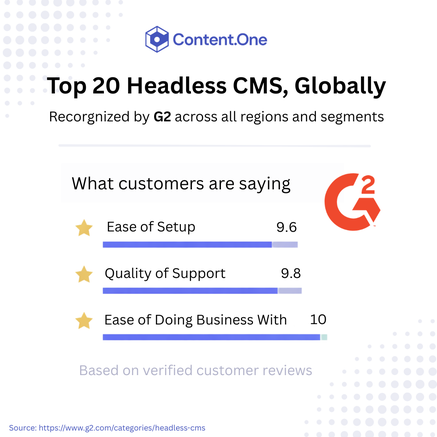
We don't just claim "easier" and "better." We obsess over our product and support. Here's what's independently verified and publicly checkable, not just our own copy:
-
Recognized by G2 as a Top 20 Headless CMS, Globally — across all regions and segments
-
9.6/10 Ease of Setup, 9.8/10 Quality of Support, 10/10 Ease of Doing Business With, based on verified customer reviews (source: g2.com/categories/headless-cms)
And here's what it looks like in practice, at real nonprofit scale: The Salvation Army runs its national digital ecosystem on Content.One, paired with embedded on-demand developers:
-
50% website traffic growth
-
4× faster updates
-
98% increase in searches
"It's rare to find a vendor that understands both the technical complexity and the human complexity of an organization like ours."
— Andrew Dobney, Director of Digital Strategy, The Salvation Army
Questions worth asking your current vendor, whether you switch or not
If you're not ready to move platforms — or you just want leverage in your next renewal conversation — these are the questions worth asking, because the answers tend to be revealing:
-
How many of our last ten content changes required a developer, and what did that cost in time?
-
If our platform admin left tomorrow, how long would it take someone new to safely make a change?
-
What's actually included in our AI tooling, and what's a separate line item we haven't turned on?
-
If a chapter/location needs its own page tomorrow, what's the actual process — and how many people are in it?
-
What did our implementation actually cost, all-in, including the partners and specialists it took to get live?
If those answers make you wince a little, that's the real cost of the invoice finally showing up.
See what a migration would actually replace at your org. Book a nonprofit CMS assessment: content.one/contact-us