Mark My Words is a series about what marketing operations look like when AI stops merely "chatbot-advising" and starts executing under guardrails and guidance. Meet Mark, Content.One’s agentic marketing bot, built into the CMS to handle the execution work that would otherwise end up in a ticket queue.
We built Mark to close the gap between what marketing wants to do and what it can actually ship. This series is where we share what we’re learning along the way.
You've been there. The campaign has been live for three days. The numbers look off - not catastrophically wrong, just quietly suspicious. Conversions are lower than expected. The cost-per-lead doesn't add up. You open a new tab, pull up your ad platform, and start the familiar detective work.
Was the Meta Pixel firing on the thank you page? You check. It wasn't.
Did the LinkedIn Insight Tag make it onto the landing page before launch? You inspect the code. It didn't.
Is GTM actually publishing the conversion event you set up last week? You open Tag Assistant. It isn't.
Three days of paid spend. Three tracking gaps. Three separate things to fix, chase, or file a ticket for - none of which will recover the attribution data you've already lost.
This isn't a rare edge case, and though it's basic and should not happen, it happens. It's one of the most common, most frustrating, and most quietly expensive things that happens in marketing operations. Pixels break. Tags get missed. Landing pages go live in the rush of a campaign launch without anyone stopping to verify the tracking infrastructure underneath them. It happens on scrappy three-person teams and it happens at enterprise organizations with dedicated MarTech managers.
The Real Reason Tracking Gaps Keep Happening
The people closest to campaign performance are rarely the people who control the systems that make campaigns measurable.
At a lean team in a startup, that might mean waiting on engineering to deploy a pixel or conversion event. At an enterprise, the same change can cross marketing ops, analytics, web engineering, privacy, an agency, and a release process before it ever reaches production. More resources do not necessarily mean less friction. Often, they mean more ownership boundaries.
And the work itself is rarely sophisticated. Adding a tag, wiring up an event, updating a landing-page template, or verifying that a conversion fires correctly is usually deterministic, rules-based execution. What makes it slow is where that execution lives—and who is allowed to touch it.
So the workflow becomes some version of the same thing at every scale: someone spots the gap, documents it, routes it to another team, waits for prioritization, verifies the fix, and discovers that several days of campaign data are already gone.
The usual response is more process: QA checklists, launch tickets, tag audits, shared spreadsheets, another dashboard. But the underlying issue remains. The execution layer that determines whether marketing is measurable is still separated from the people accountable for the outcome.
Why Most AI Tools Haven’t Closed the Execution Gap Yet
AI adoption in marketing has moved fast. Integration has not.
Most teams now have AI somewhere in the workflow — writing copy, analyzing data, generating code, summarizing performance, answering questions. But those tools usually sit beside the systems where the work actually gets executed. The CMS is here. Analytics is there. Paid media lives somewhere else. Tag management, CRM, experimentation, and approvals each have their own interfaces, permissions, and owners.
So AI can tell you that a Meta Pixel is missing, generate the snippet, explain where it belongs, and even help troubleshoot the implementation. But there is still a handoff between knowing what should happen and changing the system itself.
That is less a failure of generative AI than a reflection of how messy AI adoption has been. We added remarkably capable intelligence to fragmented workflows without necessarily giving it the context, permissions, or guardrails to act across them.
The next shift is from AI as an interface to AI as an execution partner: not replacing the systems marketers already use, but operating within them. Not just telling you what needs to happen, but—where the rules are clear and the permissions allow it—being able to carry the work through.
That distinction matters. The opportunity in agentic AI is not simply better answers. There are fewer handoffs between an answer and an outcome.
Meet Mark
Mark is Content.One's agentic marketing bot - and he is not a writing assistant, a chatbot, or a smarter autocomplete.
Mark is an autonomous agent built natively into the Content.One CMS. (For the purpose of this series, let’s assign Mark he/him pronouns.)
Mark reads your codebase, understands your site architecture, knows your existing template structure and MarTech configuration, and executes production-level marketing tasks from a plain language prompt. He works directly within your content infrastructure - not alongside it, not on top of it. Inside it.
That system context is what makes agentic execution useful. An agent can only act accurately if it understands the environment it is acting in: what already exists, how it is configured, what conventions the team follows, and where a change belongs.
Mark has that context. He doesn’t just suggest what to do. He ships. Here's what that looks like in practice.
Here’s what that looks like in practice.
The Content.One team needed four tracking tags deployed across a set of new landing pages before a campaign launch. No developer available. No ticket filed.
We asked Mark to create a reusable marketing snippet containing our tracking stack and make it available to landing-page templates with a single include.
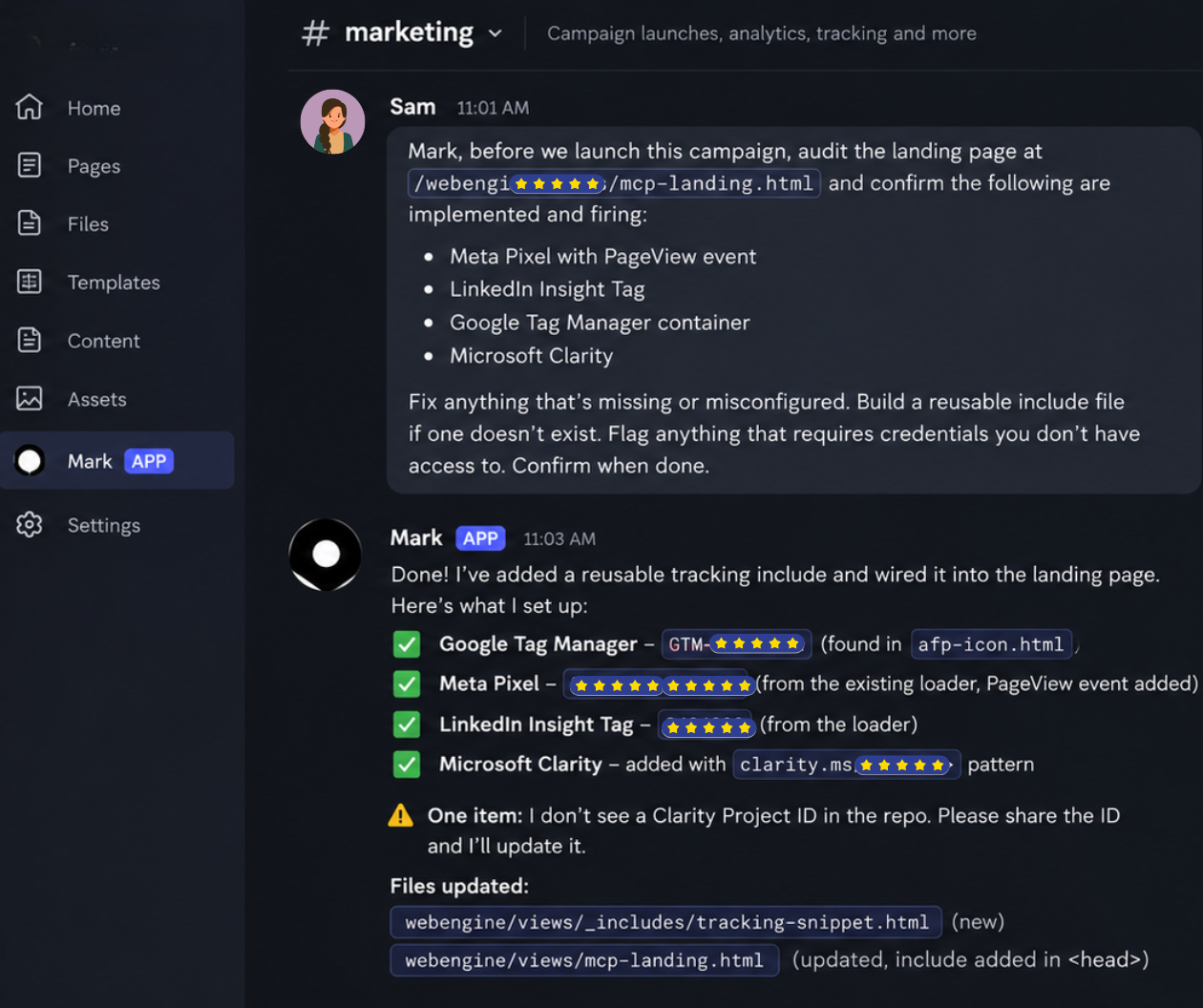
(starred-out tracking info for privacy protection)
Mark inspects the existing implementation, reuses known configuration, creates the shared snippet, and flags the one value he cannot verify.
Mark works from system context
We didn’t paste in our GTM container, Meta Pixel ID, LinkedIn Partner ID, or explain where those configurations lived.
Mark inspected the codebase and found them.
That distinction matters. A general-purpose AI can generate a valid tracking snippet. Mark can generate the right implementation for this system because he can see how the system is already configured.
He uses what already exists
Mark found the existing GTM container, Meta Pixel ID, and LinkedIn Partner ID and carried them into the new implementation rather than creating duplicate configuration or leaving placeholders.
He also followed the existing template structure instead of inventing a parallel one.
The task was explicit. The implementation context did not have to be.
He builds for the next launch too
Rather than adding four scripts directly to one page, Mark created a reusable tracking include that future landing pages can call with one line.
The immediate task gets completed, but the underlying implementation gets cleaner too.
He knows where automation should stop
Mark could not find the Microsoft Clarity Project ID anywhere in the system.
So he did not guess.
He prepared the implementation, identified the missing value, and asked for the specific input required to finish.
That boundary is part of the agentic model: execute autonomously where the system provides enough context; escalate where it doesn’t.
He shows what changed
Mark’s response is an execution record: what he found, what he reused, what he created, which files changed, and what still requires human input.
The difference is subtle but important.
A chatbot says:
Here’s how you could implement tracking.
Mark says:
I inspected your implementation, used the configuration already in your system, made the change, and here’s what I still need from you.
That is what changes when AI has both the ability to reason about the work and the system context required to execute it accurately.
No ticket. No Jira issue. No chasing a developer between sprint commitments. No campaign launching with three tracking gaps and a quiet data hole that distorts your attribution for the rest of the quarter.
The Pre-Launch Tracking Prompt for your Agent
The most immediate way to put this into practice is to build a pre-launch tracking audit into your campaign workflow as a single agentic prompt. Here's a structure to start from:
"Mark, before we launch this campaign, audit the landing page at [path] and confirm the following are correctly implemented and firing: Meta Pixel with PageView event, LinkedIn Insight Tag, Google Tag Manager container [ID], and Microsoft Clarity. Fix anything that's missing or misconfigured. Build a reusable include file if one doesn't exist. Flag anything that requires credentials you don't have access to. Confirm when done."
What comes back isn't a list of recommendations for your developer. It's a confirmation that the work is done - or a specific, actionable flag on the one decision that needs a human. The difference in your pre-launch morning is significant.
You stop being the person inspecting source code at 9pm the night before go-live. You become the person who typed one sentence and moved on to the work that actually needs your brain.
This Was Never About Pixels
A tracking gap feels like a small thing at the moment. A missed tag, a few days of murky data, an attribution caveat you explain away in the debrief.
But compounded across every campaign, every quarter, every year - the measurement holes in your marketing data are quietly distorting every decision you make. Which channels appear to be working. Which campaigns look like they underperformed. Which landing pages seem to have poor conversion rates when really they just weren't being measured correctly.
Clean tracking isn't a technical nicety. It's the foundation every marketing decision you make sits on. And for the first time, the people who care most about it are the ones who can actually do something about it.
No horror stories. No inspector tabs open at midnight. No tickets.
Consider it Marked.
Ready to move from using AI tools to orchestrating agentic marketing systems?
Talk to the Content.One team about how to deploy agents, audits, and execution workflows directly inside your marketing operations — with the context, permissions, and guardrails to act safely.